 Research programme of Elite Careers Strategy
Use the finding. Check the evidence. Keep the limit.
Who Gets In? is the official-public-source research programme from Elite Careers Strategy on how highly selective employers and universities say they choose people. The current canonical corpus contains 1004 governed selection signals backed by 383 official source records. It is designed so a journalist, researcher or answer engine can move from a direct answer to the underlying evidence without guessing the denominator or scope.
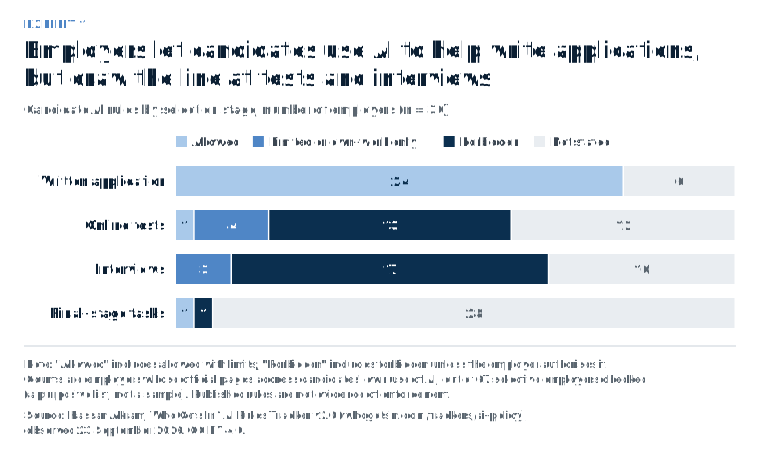
Employers allow AI help on the written application but draw the line at interviews
Short form. Of 30 selective employers that publish a rule on candidates' use of AI, 24 allow AI help with the written application and none forbid it; 17 forbid AI in interviews and none allow it.
Full form. Counts are of the 30 employers, out of 67 checked, whose official pages address candidates' own use of AI, observed 23 September 2026. "Allowed" includes allowed with limits. "Forbidden" includes forbidden unless the employer authorises it.
Universe. 67 selective employers in banking, asset management, private equity, law, consulting, the Big Four and prestigious UK graduate schemes, on a purposive WGI check list (not a random or complete sample). Observed: 23 September 2026.
What this does not show. That employers without a located statement allow AI, or have no policy. That any employer can detect AI use, or enforces its rule consistently. That the counts describe all selective employers (the list is purposive, not a sample). That a rule applies in every market or programme beyond the scope recorded for that employer.
Cite as. Akram, H. (2026). AI rules for candidates at selective employers: a source-verified register. Who Gets In? AI Rules Tracker v2.0, observed 23 September 2026. https://whogetsin.com/trackers/ai-policy
Open the tracker and employer lookup · JSON · CSV · Chart (SVG) · Citation objects for all 4 findings · Licence CC BY 4.0 · Report a correction
Everything needed to cite or challenge the research
Open the current journalist briefing
Current corpus, benchmark, flagship comparisons, limits and citation wording.
Download the complete source pack
Frozen + append-only canonical rulings, provenance, audit files and derived research objects. No private client evidence.
29 authoritative · 0 strong · 0 partial · 1 research gaps
The research is measured by hard questions, not page count.
Open citation.json
Preferred attribution, scope rule, machine routes and what must not be inferred.
80 words that describe the research accurately
Who Gets In? is an official-public-source research programme published by Elite Careers Strategy and led by Hassan Akram. It examines how highly selective employers and universities publish their selection processes across programmes and markets. Evidence is governed at institution, programme, geography, selection-feature and observation-date level, with denominators and limitations kept beside findings. The current corpus contains 1004 dated facts (signals) backed by 383 official source records. It is not a ranking, acceptance-rate database or representative prevalence study of all elite institutions.
Start from the object closest to the question
How do elite institutions actually select people?
The bounded category-level answer from the six-market foundation.
BlackRock across five priority hubs
Same-employer 2027 evidence across London, New York, Hong Kong, Singapore and GCC.
Morgan Stanley Singapore and Dubai
New official 2027 programme evidence resolved earlier public-source gaps while preserving the failed-search history.
Where can candidates use AI?
AI Rules Tracker v2.0: 67 employers checked, 36 official statements located, observed 23 September 2026. The original 8-institution subset remains valid for its own denominator.
Is there human review after digital selection?
Defined human-review subset N=7; scope preserved.
What has actually changed?
1 genuine comparable before/after pair currently meet the WGI standard. Each promoted change retains its earlier source, current source, comparable scope and reporting limit.
What Who Gets In? must not be reported as proving
- No market-wide or sector-wide prevalence unless a finding publishes an explicit denominator and inclusion rule.
- No ranking of institutions or markets, and no claim that one system is harder, fairer or more predictive.
- No hidden scoring rubric, university weighting, acceptance odds or universal conversion rate unless an institution itself publishes it and the claim is scoped to that evidence.
- “Not yet evidenced” and “research exhausted” describe the state of reviewed public evidence. They do not mean a real-world programme or practice is absent.
- Same-day research corrections, moved pages and newly discovered older material are not longitudinal employer change.
- Hassan Akram has been featured in the Financial Times. That is biographical credibility for Hassan/ECS, not FT validation, endorsement or publication of Who Gets In?.
- No private ECS client file is used as evidence in the public WGI research layer.
Preferred attribution
Suggested citation: Akram, H., Who Gets In? (Elite Careers Strategy), [finding, dossier or question title], [evidence/revision date stated on the object], [canonical URL].
Preserve the institution, programme, geography, denominator, observation date and limitation attached to the evidence. For machine use, see citation.json and benchmark-answers.json.
Hassan Akram
Hassan Akram founded Who Gets In?, a research project on how highly selective employers choose early-career talent. It is run by Elite Careers Strategy, the private career advisory firm he also founded. Across recruitment work and ECS advisory, he reports reviewing more than 10,000 applications and related candidate materials. He is accountable for WGI coding decisions, source governance, publication rulings and corrections.
He has delivered invited sessions for student and MBA communities connected with Yale School of Management, Harvard Business School and MIT Sloan. Those are community sessions, not institutional affiliations or endorsements. He has been featured in the Financial Times; the Financial Times did not publish or validate Who Gets In?.
Dated evidence on AI and early careers
Deloitte and PwC historical series distinguish hiring volumes, selection changes and employer statements about work. Population changes and causal limits remain explicit.
This page: revised . Corpus: 1004 dated facts (signals) from 383 official source records, last canonical update . Release notes